Categories
40th Anniversary

Harness Goat Society – 40th Anniversary Year

In 1986 the Harness Goat Society was formed. It still remains today; a dynamic society with active members, promoting and demonstrating the abilities of our amazing animals.
So where the heck did the idea of a goat in harness come from? You maybe surprised the hear the simple answer is about 4,000 years ago!


The oldest recorded reference was found in Crete on a ring. Dated roughly to around 2,000bc the precious stone had carved into it a chariot pulled by a pair of goats. There is also a record of a goat pulling a plough in Crete at about the same time.


A harnessed goat appears many times in mythology. Thor the ‘God of Thunder’ was pulled across the heavens in a chariot powered by goats, each time he threw his hammer it caused thunder and lightning.


Jumping forward towards the start of the 20th Century, King George V is seen in his wedding photograph dated 1893 with children in a goat carriage. Many European families owned a goat cart or carriage for their children to enjoy, from lower classes up to royalty. Whilst the former built very basic carts from recycled materials, the latter, of course, had some very elaborate vehicles. The son of Napoleon and Empress Eugene had an impressive calash, drawn by a white goat. This apparently was the prince’s favourite ‘toy’.


Sadly, in the second decade of 20th century, it would have been quite normal to see a goat cart on the streets in many countries across the world. The First World War claimed the lives of thousands of horses and an easy and (usually) amenable replacement was a goat. Disabled people also made use of them and photographs dating from 1914/18 war show injured soldiers riding in goat carts.


Harness makers of the period showed goat harness patterns in their catalogues. They would all be made from leather. The poorer classes would
make rough harness from upholsterer’s jute webbing. It may be of interest that both car makers, Peugeot and Studebaker (in America) started from very humble beginnings, advertising goat and dog carts for sale.

Many different items were carried in the carts, besides children. Milk was delivered, vegetables, barrels of water, and in America “Buck Beer” was
advertised being transported in a goat cart. It is known that basket makers used goat carts to carry willow shoots, and another goat cart was used by a travelling salesman selling kitchen ware.


In 1891, came the introduction of bank holidays and with the advent of railways, towns people were able to travel to the seaside for a day out. Cottagers living near the coast saw a marketing opportunity and pressed donkeys and goats into service. The donkeys carried ladies up and down the beach, their saddles covered with a white cotton cloth to avoid soiling the riders’ fine clothes and goats pulled tiny carriages giving rides to children. Local councils at seaside resorts later licensed all operators giving goat carriage rides In Brighton, the last known Harness Goat licence was issued in 1953.


During the Second World War a pair of goats was used to draw a small trolley carrying food to the forward troops, and due to the scarcity of petrol, horses, donkeys, and goats again became popular drawing carts In truth goats have been used over the centuries to carry pack saddles or pull
carts, transporting varied goods. The goat has proved itself to be a very versatile working animal. In the Himalayas goats are still used today as they
have been for centuries, carrying pack saddles loaded with luggage across rough terrain that motor vehicles either struggle with or simply can’t manage.


During the 21st Century in the UK very few goats are used for ‘true work’. Our fortune and economy mean that goats in harness are merely used for tourism, entertainment, education and a hobby. Although one American member of the harness goat society did until very recently use his goat to collect his weekly groceries from the local supermarket. Goats have in the past few years been used to pull; ice-cream selling carts at a petting zoo, Children at fetes and charity events, a teenager to her end of school prom and just to take their owners for a relaxing cart ride around their local communities.


Whenever those people, lucky enough to share their lives with a harness goat, take their goats out into public they are inundated with people wanting to share their experiences of goats, explaining why they have a unexplained love for the animal, or wanting to take a million pictures and post on social media.


People have a deep affection for goats, and as any goat owner knows goats have a deep affection for people.

The Harness Goat Society currently has nearly fifty members (and are always seeking more). Many of these are active members with goats. The society runs events, workshops and attends numerous fetes and agricultural shows through the year to promote a lifelong love for the goat and to explain and educate the general public in how versatile and amazing the goat is as an animal.


As anyone reading this, fortunate enough to own goats, knows they are intelligent and quick to learn, so pulling a cart or carrying a pack is a task they take to relatively quickly and easily. The training of a goat in harness is an excellent use of a Wethered goat also?
So we ask anyone who has an interest in goats to consider the novelty of having a goat in harness and to consider joining the Harness Goat Society and helping the society progress and move into its fifth decade.
Categories
Uncategorized

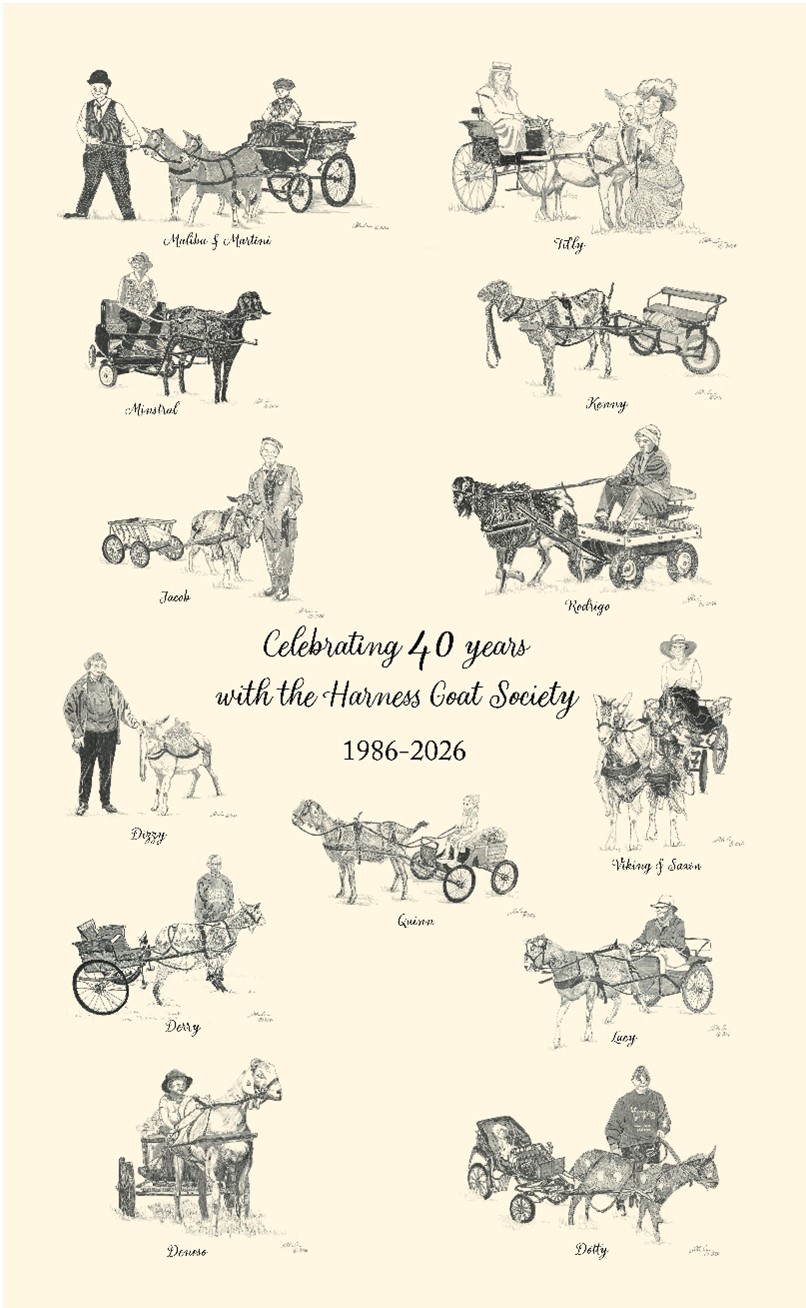
HGS 40th Anniversary Tea towel

Can you believe that the Harness Goat Society celebrates its 40th birthday this year!

It’s a huge achievement to have reached this milestone. 


In recent years our membership has grown and become worldwide. Through our presence at shows and other events members have introduced many many people to harness goats, something the vast majority of people didn’t know ever existed, and given pleasure to hundreds of children – and adults- who have enjoyed seeing and petting our wonderful goats. 


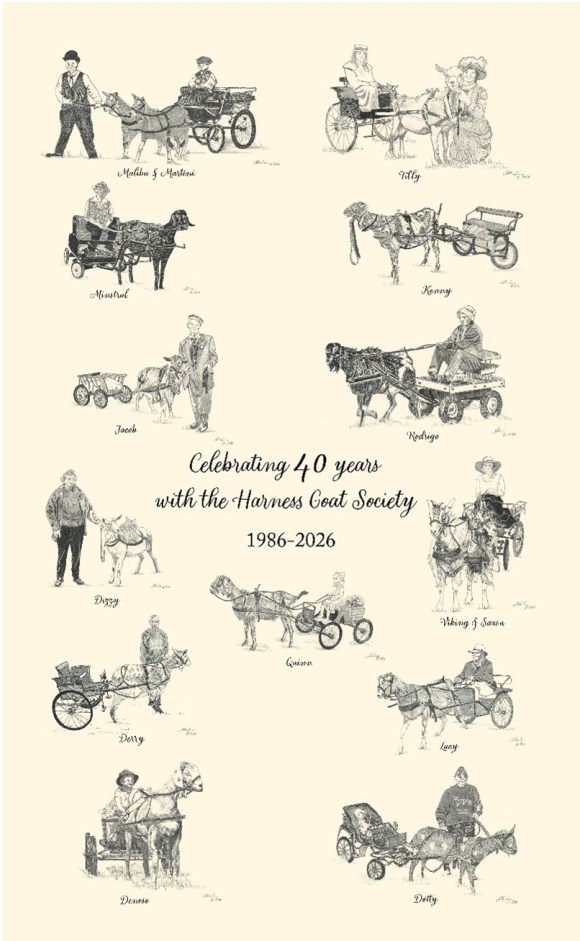
To celebrate this commemorative year we have commissioned animal and wildlife artist, Anna Cara, to produce drawings from photos from the four decades for an anniversary tea towel. 


Anna, who is a member of HGS, has given her time and expertise entirely free. She says: “I was both honoured and daunted to be asked to produce these drawings. My medium is pastel and I work in colour so pen and ink drawings is not my fortê. I’m also not at all familiar with harnesses so trying to work out from photos what was harness and what was goat or cart was somewhat challenging, particularly from the older photo.  I must also point out that I don’t draw people!!  I do hope that members will feel that I have at least done their goats justice and will buy lots of tea towels to raise funds for this wonderful Society.”

ORDER YOUR COMMEMORATIVE TEA TOWELS NOW!

Harness Goat Society 40th anniversary tea towel
Categories
Uncategorized

Harness Goat Society in the US

It’s the 26th April 2022 and two of our committee members (Paul and Sally) are heading north east from New York City to visit one of our international members.

We sit on the express train through White plains and Hawthorne, Dover plains, Tenmile river and more rural parts of this interesting state.

Our intention is to meet with George, and to spend a couple of days talking about goats, how goat keeping in the US is different to the UK and Sally is tasked with assessing George’s harnessed goats and offering advice, guidance or both.

We arrived after a couple of hours on the train at a station called Wassiac – deep into the state of New York, to be met by George. He drove us the short distance to his lovely home to meet his chickens and most importantly,for us, his eight goats.

His home is a lovely; a quaint, quirky and homely wooden house with a gorgeous wooden barn right next door and the house looks over his three acre pasture and small vegetable garden. George explained that growing food is a challenge, not just due to the large snow fall in winter but also because he has to defend his veggies from deer, raccoons and groundhogs which love to dig up anything he plants!

We move on to the stars of our trip.Two entire males, a wether, two females and three adorable kids that Sally and I stated within five minutes that we both intended to steal!

George’s herd is made up of toggenburgs and a breed that neither Sally nor I had encountered before – Lamancha, a breed Spanish in origin, George informed us. These goats are a joy and delightful, curious looking to begin with but soon totally captivating. They are marked in a manner similar to an English but also have what we would describe as the Swiss stripes down their faces. They are large in size, same size, if not slightly taller than a Toggenburg. But the thing that makes them stand out is their total lack of ear pinner. They have ears, well, ear canals, protected by hair but no other obvious sign of an ear. This is a genetic perculiality of the breed. Striking and different looking they most certainly are, but the kids especially (Thutmose and Nefertiti) just melted our hearts.

George’s aim is to get his male lamancha (Rodrigo) fully in harness and working to collect groceries. His entirety however is causing George problems in ‘attitude’. Any of the members who have shared their holding with an entire male will know exactly what is meant here!

George has two other male goats one entire and one wether.

After meeting the goats and George prising Maximilian (a single toggenburg kid) and totally gorgeous, from my hands as I was now smitten, we hatched a plan for the following day. Behind George’s lovely home is a bike trail. Our plan was to harness up the male lamancha (Rodrigo) and walk both him, the male toggenburg (Heinz) and the wether (Nijinsky) and walk along the trail with them.

Day two

After George collected us from the cottage we were staying in, Sally gave George an instructional session on harnessing using Rodrigo. George has a cart (he called it a wagon) for him. He was concerned that the shafts of the wagon, though designed for a goat were a little short. When he and Sally brought the cart to the goat, as she explained… goat stands and cart brought to the goat, not goat backed into the cart’, it was clear George’s suspicions were correct.

Therefore Rodrigo was relieved of his harness and we all set off to both George’s garage and the hardware store with lashings of plans and excitement of how to solve the problem.

I felt this was like an episode of macyver (a tv program from the eighties) but no one else knew what I was talking about!

To cut a long story short, we found bits and pieces to lengthen the shafts by around fourteen inches (35cm – for those in the UK!).

Rodrigo was duly re-harnessed and this time attached to the wagon. Rodrigo is a very large,strong and opinionated goat but slowly under Sally’s guidance and George’s vocal commands within forty five minutes he was pulling George in the wagon around George’s garden. Now we all know ‘one

swallow doesn’t make a summer’ so let’s not pretend Rodrigo took to his workload with grace and acceptance. There would still be work to do for George, lots of it, but Rodrigo did go in harness and he did pull George, whilst he sat in the wagon.

So first job successfully completed.

Next it was the turn of the wether Nijinsky. Being a wether this was a far calmer, easier (he is a smaller toggenburg) experience and most importantly safer. Both Sally and I immediately impressed our opinion on George that Nijinsky is potentially the better goat to work with as is both calmer and consistent, but it is neither our goat or decision.

Nijinsky being a little smaller fitted into the wagon slightly more easily than Rodrigo, and again with Sally’s guidance was soon pulling George around the garden. It must be said without the enthusiasm of Rodrigo but Sally stated to George she could see massive potential but he needed work to build confidence.

So second task successful.

The last job of day to was to walk Rodrigo, Nijinsky and the other entire male (Heinz) up the trail, just for fun, but of long reining and browsing some verges and hedgerows.

Both Rodrigo and Heinz were very pleased to be out, Nijinsky though, being less confident, slipped his head collar less than ten metres from home and calmly walked back! (I ask you, who’d have a goat!!!).

The other two however had a grand time and Sally suggested that Heinz would make an excellent pack goat as he was so stable, yet strong, and would be able to easily carry George’s groceries from the store.

So task three of the day successful (well partially).

A plan was hatched for the final day of our time with George to re-harness both Rodrigo and Nijinsky. A second training session under the tutelage of Sally should build some confidence in both Nijinsky and George in his harness technique but also to try to focus Rodrigo on his new role at home.

Day three

Wow, what a difference a day makes?!

On day three Sally and George harnessed Rodrigo and attached the wagon. The wild and strong minded goat had ‘reflected’ over night and was far less ‘enthusiastic’ and more willing to listen and seemingly understanding of the task. He pulled George in a circular route around his garden when following Sally. He did struggle still with cornering but that will come. George said he would work on Rodrigo moving in straight lines to begin with , getting of the wagon to turn until Rodrigo is confident and will then work on turning.

Nijinsky however was a different story, we were hoping that his ‘reflection’ would have built a little confidence. He is however still very unsure, He walks well but is occasionally spooked into running, or nervously stops. Sally and myself still think that he has the potential to be n excellent harness goat, he just needs time, consistency and treats to build his confidence.

Our final task with George was to put a pack on Heinz. Sally showed George how the pack should be fitted and where it should be sited.

George declared he would like him to work as a pack goat, using him to pick up and collect trash along the cross trail (a public footpath/bridleway/cycle track).

Heinz was duly brought into the barn and the pack fitted…Heinz barely reacted and continued to walk graze and be completely normal, seemingly not even noticing the pack.

By this time, and sadly, Sally and I had a train to catch so needed to leave George.